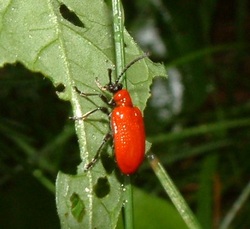
This photo shows a lily leaf beetle eating a plant that lily aficionados will immediately realize is definitely not a lily. It is Solanum dulcamara, climbing nightshade, a plant in the same genus as tomatoes, potatoes and eggplants. It is easy to understand that lily leaf beetles attack plants that are closely related to lilies, such as fritillarias. But nightshade is not at all closely related to lilies. The evolutionary lineages leading to the genus Solanum on the one hand and the genus Lilium on the other split from each other back in the Jurassic Period, when dinosaurs dominated Earth’s fauna. This deep evolutionary separation would lead us to expect that lilies and nightshade would be fundamentally different—and they are in many ways. So why does climbing nightshade attract lily beetles?
Despite the evolutionary distance between lilies and nightshade, there are similarities in the chemical compounds they use to defend themselves from herbivores. Nightshade belongs to a plant family, the Solanaceae, that is characterized by potent alkaloid chemicals, such as nicotine in the tobacco plant Nicotiana tabaccum. Although lilies are less well known for their toxicity, many contain steroidal glycoalkaloids, just like plants in the genus Solanum. Apparently this chemical similarity is enough to entice lily beetle adults to feed on nightshade.
Even the most toxic plants have at least a few herbivores that have evolved the metabolic capacity to detoxify their host plant’s potent chemicals. The herbivores often use the chemicals as cues to find their host plants. Many of these herbivores then use their host plant’s chemicals to defend themselves against their own natural enemies. A relative of the lily leaf beetle, the three lined potato beetle Lema trilinea, feeds on nightshade, and the larvae incorporate the plant’s alkaloids into the fecal shields they hold over their backs to ward off predators. Their alkaloid-laden fecal shields effectively defend them against generalist predators, such as ants. However, specialized parasitic wasps will often use the plant chemicals in the shields as a cue to find the larvae. Lemophagus pulcher, the wasp we have petitioned to release next summer, is attracted by the lily-chemical odor of lily beetle fecal shields.
When a pest herbivore incorporates a new host plant into its diet there can be important consequences for biological control. Feeding on a new host plant can provide a refuge where the herbivore cannot be found by its parasitic wasps, because the wasps rely on the visual or chemical cues of the normal host plant to find the herbivore. A good example of this is provided by the diamondback moth Plutella xylostella, an important pest of crops in the cabbage family. The diamondback moth has recently moved onto snowpeas in Africa, where it is relatively safe from the parasitic wasps that readily find and attack it on cabbage plants.
Could the lily leaf beetle enjoy a refuge from its biological control agents by feeding on nightshade? To date, the beetle has not been observed to lay its eggs on nightshade. However, the lily beetle does lay eggs, at least in the lab, on other plants that can support development of the larvae, such as Indian cucumber Medeola virginiana and claspleaf twisted stalk Streptopus amplexifolius. This summer, we plan to conduct experiments to see if the wasp Tetrastichus is confused when lily beetle larvae feed on these plants. More later...
References:
Ernst, C., Cappuccino, N., Arnason, J.T. 2007. Potential novel hosts for the lily leaf beetle Lilioceris lilii Scopoli (Coleoptera: Chrysomelidae) in eastern North America. Ecological Entomology 32:45–52
Morton, T.C., Vencl, F.V. 1998. Larval beetles form a defence from recycled host-plant chemicals discharged as fecal wastes. Journal of Chemical Ecology 24:765-785.
Rossbach, A., Loehr, B., Vidal, S. 2006. Parasitism of Plutella xylostella L. feeding on a new host plant. Environmental Entomology 35:1350-1357.
Schaffner, U., Müller, C. 2001. Exploitation of the fecal shield of the lily leaf beetle, Lilioceris lilii (Coleoptera: Chrysomelidae), by the specialist parasitoid Lemophagus pulcher(Hymenoptera: Ichneumonidae). Journal of Insect Behavior 14:739-757.
Even the most toxic plants have at least a few herbivores that have evolved the metabolic capacity to detoxify their host plant’s potent chemicals. The herbivores often use the chemicals as cues to find their host plants. Many of these herbivores then use their host plant’s chemicals to defend themselves against their own natural enemies. A relative of the lily leaf beetle, the three lined potato beetle Lema trilinea, feeds on nightshade, and the larvae incorporate the plant’s alkaloids into the fecal shields they hold over their backs to ward off predators. Their alkaloid-laden fecal shields effectively defend them against generalist predators, such as ants. However, specialized parasitic wasps will often use the plant chemicals in the shields as a cue to find the larvae. Lemophagus pulcher, the wasp we have petitioned to release next summer, is attracted by the lily-chemical odor of lily beetle fecal shields.
When a pest herbivore incorporates a new host plant into its diet there can be important consequences for biological control. Feeding on a new host plant can provide a refuge where the herbivore cannot be found by its parasitic wasps, because the wasps rely on the visual or chemical cues of the normal host plant to find the herbivore. A good example of this is provided by the diamondback moth Plutella xylostella, an important pest of crops in the cabbage family. The diamondback moth has recently moved onto snowpeas in Africa, where it is relatively safe from the parasitic wasps that readily find and attack it on cabbage plants.
Could the lily leaf beetle enjoy a refuge from its biological control agents by feeding on nightshade? To date, the beetle has not been observed to lay its eggs on nightshade. However, the lily beetle does lay eggs, at least in the lab, on other plants that can support development of the larvae, such as Indian cucumber Medeola virginiana and claspleaf twisted stalk Streptopus amplexifolius. This summer, we plan to conduct experiments to see if the wasp Tetrastichus is confused when lily beetle larvae feed on these plants. More later...
References:
Ernst, C., Cappuccino, N., Arnason, J.T. 2007. Potential novel hosts for the lily leaf beetle Lilioceris lilii Scopoli (Coleoptera: Chrysomelidae) in eastern North America. Ecological Entomology 32:45–52
Morton, T.C., Vencl, F.V. 1998. Larval beetles form a defence from recycled host-plant chemicals discharged as fecal wastes. Journal of Chemical Ecology 24:765-785.
Rossbach, A., Loehr, B., Vidal, S. 2006. Parasitism of Plutella xylostella L. feeding on a new host plant. Environmental Entomology 35:1350-1357.
Schaffner, U., Müller, C. 2001. Exploitation of the fecal shield of the lily leaf beetle, Lilioceris lilii (Coleoptera: Chrysomelidae), by the specialist parasitoid Lemophagus pulcher(Hymenoptera: Ichneumonidae). Journal of Insect Behavior 14:739-757.
 RSS Feed
